

Is Paid Internship Good or Bad? Understanding the Reality Behind Modern Training Models
Posted By:ExcelPTP
December 03,2025
Why Companies Prefer Job-Ready Candidates?
In today’s job market, one of the most debated topics among students, fresh graduates, and employers is whether paid internships are good or bad. With industries evolving rapidly and companies demanding skilled, job-ready talent, the meaning and purpose of internships has changed significantly.
- Modern companies have limited time and resources to train freshers from scratch.
Moreover, training a fresher internally often requires:
- Senior developers mentoring them daily
- 6 months to 1 year of continuous support
- Extra effort to make them ready for real projects
- Investment in tools, systems, and monitoring
However, even after this investment, many freshers leave the organization for higher packages or better opportunities.
As a result, companies lose time, money, effort, and productivity. Therefore, most organizations now follow a more practical structure.
Typically, every experienced developer needs 2–3 junior developers to distribute workload and support ongoing tasks. In this process, juniors gradually learn while contributing to smaller tasks. Nevertheless, when freshers leave soon after getting trained, the company suffers major losses.
Why Paid Internships Started?
- To balance company investment and trainee growth, many organizations introduced paid training or paid internship programs.
Under this model:
- Companies invest in teaching practical industry skills
- Trainees learn real tools, workflows, and project handling
- If trainees leave early, the company does not face a complete loss
- If trainees perform well, they receive job opportunities, stability, and career growth
Consequently, this model helps companies maintain continuity while helping trainees gain confidence and employable skills. Because of this, paid internships can be beneficial when both sides receive fair value.
The Other Side: Misuse by Institutes
- Unfortunately, not all paid internship models are genuine.
In some cases, certain institutes or organizations misuse the concept by:
- Charging high fees without providing proper training
- Not offering real project experience
- Making trainees work without proper guidance
- Creating confusion and reducing students’ confidence
Because of such experiences, many freshers start believing that training should always be free. However, in today’s competitive industry, that expectation is often unrealistic.
Are Free Internships an Ideal Solution?
Although free internships sound attractive, they often come with limitations.
In most cases:
- Companies cannot afford to invest deeply without any return
- Seniors provide limited support because they are already overloaded
- Only highly talented trainees receive proper attention
- Others are left to learn independently without guidance
- Freshers fail to gain structured and practical skills
Therefore, free internships work effectively only when the organization is genuinely committed to teaching, which is comparatively rare.
Paid Internship vs Free Internship
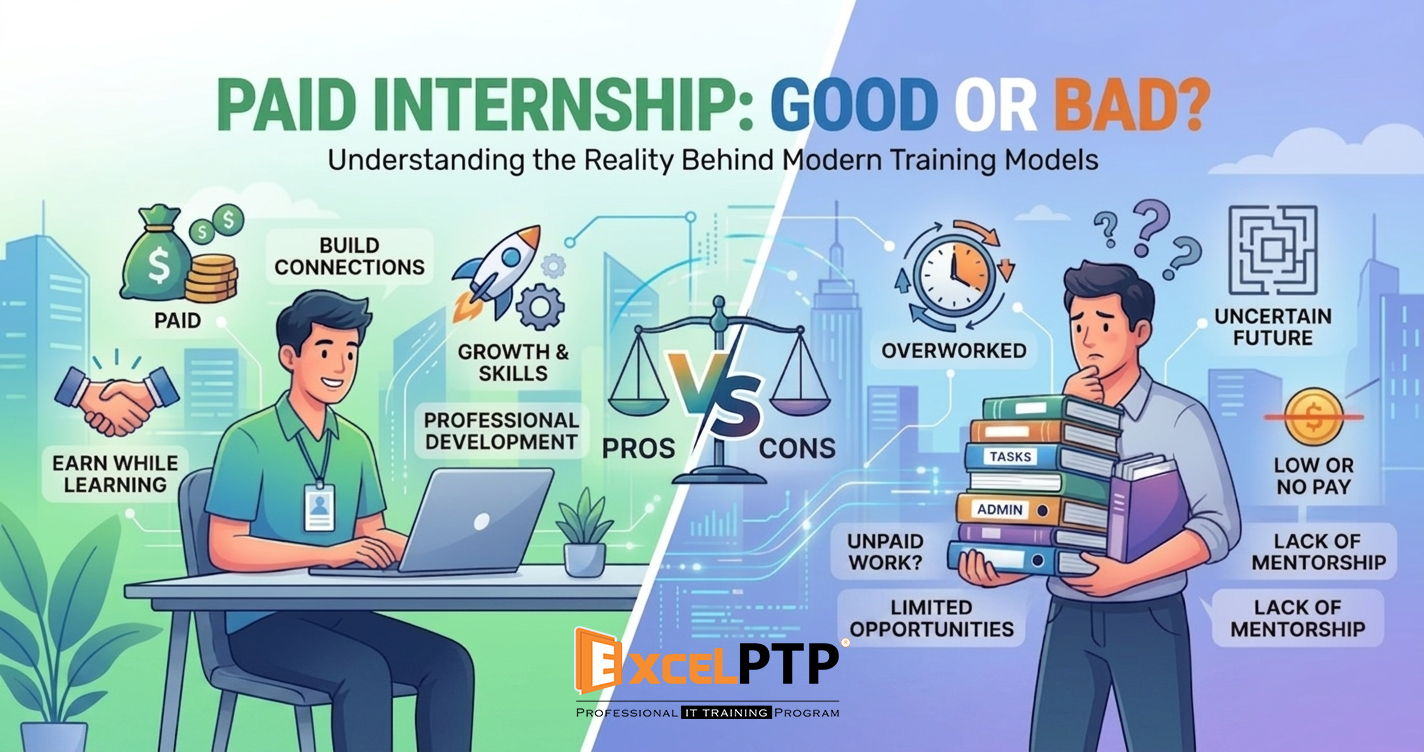
So, is a paid internship good or bad? In reality, both models have advantages and disadvantages.
Paid Internship – Pros
- Structured training programs
- Better mentor involvement and guidance
- Company investment often ensures better quality
- Trainees become job-ready faster
- Creates a mutual value exchange
Paid Internship – Cons
- Risk of misuse by low-quality institutes
- Trainees may feel financially burdened
Free Internship – Pros
- No financial pressure on trainees
- Opportunity to explore industries without investment
Free Internship – Cons
- Limited support from senior professionals
- No structured training process
- Slow skill development
- Often no job assurance or long-term growth
Final Verdict: It Depends on the Trainee
If a trainee is serious, motivated, and ready to learn, then a good paid internship can accelerate their career growth significantly.
However, trainees must choose a reliable, transparent, and industry-backed program instead of joining random institutes.
On the other hand, if someone only wants basic exposure, then a free internship may be enough.
What Truly Matters in Any Internship?
- Ultimately, the value of any internship paid or free depends on several important factors:
- The trainee’s learning ability
- Their commitment and consistency
- The organization’s training quality
- The real industry exposure they receive
Contact us for more information and free career counselling. We will help you choose the right career path from scratch based on your abilities, interests, passion, and current industry demands in today’s AI-driven market.
NEW COURSES


Contact Us
Trending Courses
Popular Posts
-
 December 3, 2025 Top 10 IT Training Courses For fresher india
 -

-
 December 3, 2025 10 Software Course You can learn in 6 Weeks or less