
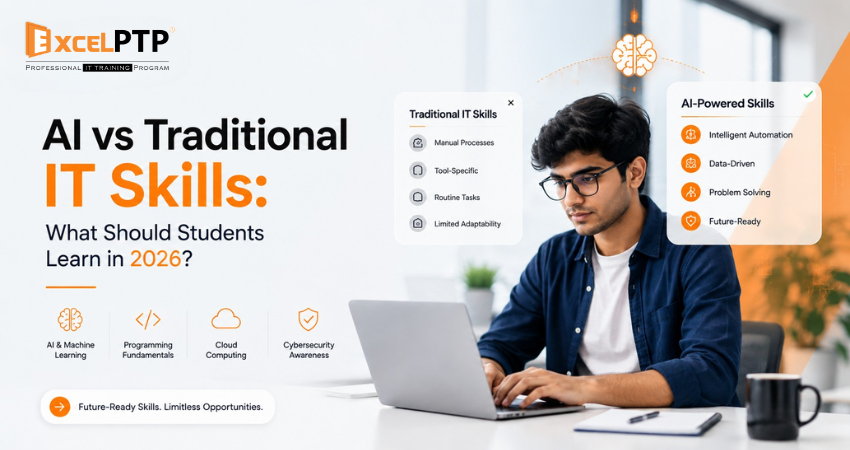
AI vs Traditional IT Skills: What Should Students Learn in 2026?
Posted By:ExcelPTP
August 25,2026
Every year, thousands of students in Ahmedabad and across India ask the same question before choosing an IT course: should they learn traditional IT skills like coding, networking and databases, or should they focus entirely on AI skills for students such as prompt engineering, machine learning and generative AI tools? In 2026, this is no longer an either-or decision. The real answer lies in understanding how AI vs traditional IT skills work together in today’s hiring landscape, and how students can build a career-ready skill set that employers actually want.
This guide breaks down the difference between AI and traditional IT skills, explains which skills are still in demand, and helps you decide what to learn first based on your background, whether you’re a fresher, a non-IT graduate, or someone planning a career switch to IT.
Quick Answer: What Should You Learn First in 2026?
Most students should still start with core traditional IT skills programming fundamentals, databases, and problem-solving logic because these form the foundation almost every IT job requires. Once that foundation is solid, layering in AI skills such as prompt engineering, AI-assisted coding, and basic machine learning concepts makes a candidate significantly more employable. Employers in 2026 are not looking for AI specialists only; they are looking for IT professionals who can use AI tools effectively within a traditional role.
Understanding the Difference: Traditional IT Skills vs AI Skills
What Are Traditional IT Skills?
Traditional IT skills refer to the foundational technical abilities that have driven the software and IT services industry for decades. These include:
- Programming languages such as Python, Java, and JavaScript
- Web development (HTML, CSS, frameworks, full stack development)
- Database management (SQL, database design)
- Software testing (manual and automation testing)
- Networking and server administration
- Mobile application development
These skills remain the backbone of almost every IT role, from software developer to QA engineer to system administrator. Companies still build, maintain and scale applications using these fundamentals, and this demand is not disappearing in 2026.
What Are AI Skills?
AI skills are newer capabilities that have grown rapidly with the rise of generative AI and automation tools. These include:
- Prompt engineering for AI tools
- Working with generative AI platforms for content, code and design
- Basic understanding of machine learning concepts
- AI-assisted development (using AI coding assistants effectively)
- Data analysis with AI-powered tools
Unlike traditional IT skills, most AI skills for students in 2026 are not about building AI models from scratch that still requires advanced data science and machine learning expertise. Instead, they are about learning to use AI tools intelligently within an existing IT role.
Why This Comparison Matters: Search Intent Behind “AI vs Traditional IT Skills”
Students searching for this topic are usually trying to solve one of three problems: choosing the right course after graduation, deciding whether their current skill set is still relevant, or figuring out how to stay competitive as AI tools become common in the workplace. The honest answer is that traditional IT skills combined with practical AI knowledge not AI alone is what recruiters are prioritising in 2026.
How AI Is Changing (Not Replacing) Traditional IT Roles
Software Development
AI coding assistants now help developers write boilerplate code faster, but they still require a programmer who understands logic, debugging and system design to review and correct the output. A developer with strong full stack development fundamentals who also knows how to use AI tools efficiently will always outperform someone who only knows how to prompt an AI without understanding the underlying code.
Software Testing
AI is increasingly used to generate test cases and detect patterns in automation testing, but manual testing skills, domain knowledge and the ability to identify edge cases remain irreplaceable. Students learning software testing training in 2026 benefit most by combining manual and automation testing skills with AI-assisted test generation tools.
Digital Marketing and SEO
AI has transformed keyword research, content drafting and campaign optimisation, but strategy, brand understanding and human judgement still drive results. A digital marketing training path that includes AI tools alongside core SEO and campaign fundamentals gives students a real edge.
Web Development and Mobile App Development
AI tools speed up prototyping and reduce repetitive coding tasks, but client requirements, UI/UX decisions and app architecture still need a trained developer. This is why practical, project-based training continues to matter more than tool familiarity alone.
Skills That Are Still in High Demand in 2026
Based on current industry hiring patterns, the following combinations are most valuable for students entering IT:
- Python programming + AI tool proficiency useful for development, automation and data-related roles
- Web development (HTML, CSS, JavaScript, frameworks) + AI-assisted coding tools
- Software testing (manual + automation) + AI-based test case generation
- SEO and digital marketing + generative AI content and research tools
- Database and server fundamentals still essential regardless of AI adoption
Notice that in every case, the traditional skill comes first, and the AI skill enhances it. This is the practical approach ExcelPTP recommends to students choosing a course in 2026.
What Should Different Types of Students Choose?
Freshers and Recent Graduates
Start with a core technical skill such as web development, Python, or software testing, and learn how to responsibly use AI tools alongside it. This gives recruiters confidence that you can build and troubleshoot, not just prompt an AI.
Non-IT Graduates
If you are a B.Com, BBA or arts graduate exploring an IT career without a technical background, practical, beginner-friendly training in areas like digital marketing, SEO or software testing supported by AI tool training is often the fastest realistic entry point into IT.
Career Switchers and Working Professionals
If you already have IT experience, adding AI skills such as prompt engineering or AI-assisted development to your existing expertise can help you stay ahead without starting from scratch.
How ExcelPTP Helps Students Build the Right Skill Combination
ExcelPTP offers practical, hands-on IT training in Ahmedabad designed around real industry needs, not just theory. Training programmes cover core technical skills including web development, software testing, digital marketing, SEO, and mobile application development with one-to-one guidance, live-project exposure, career counselling, and placement support. Students also get exposure to AI, prompt engineering and generative AI tools as part of building a well-rounded, future-ready skill set, rather than treating AI as a separate or standalone subject.
Final Thoughts: Build a Career-Ready Skill Set, Not Just an AI-Ready One
The debate between AI vs traditional IT skills is less about choosing sides and more about sequencing your learning correctly. In 2026, the most employable students are the ones who master core IT fundamentals first and then confidently apply AI tools to work faster and smarter. This combination not AI alone is what gives students a genuine advantage in a competitive job market.
Ready to build the right mix of traditional and AI-powered IT skills? Get free, personalised career counselling from ExcelPTP’s training experts and find the course path that fits your background and career goals. Talk to a Career Counsellor today and take the first step toward a future-ready IT career.
Frequently Asked Questions
Is AI replacing traditional IT jobs in 2026?
No. AI is changing how IT tasks are performed, but it is not replacing the need for skilled professionals in development, testing, networking and digital marketing. Most companies use AI as a productivity tool alongside human expertise, not as a replacement for it.
Should a complete beginner learn AI or traditional IT skills first?
A complete beginner should start with a traditional IT foundation such as programming basics, web development, or software testing. AI tools are far more useful once you understand the underlying logic and workflow of your chosen field.
Can I get an IT job in 2026 by only learning AI tools?
It is unlikely. Most employers still require core technical skills for IT roles. AI tool knowledge is considered a valuable addition, not a substitute for foundational IT training.
Which traditional IT skills are still worth learning in 2026?
Web development, Python programming, software testing, database management, and digital marketing/SEO remain strong, stable choices with consistent hiring demand.
Does ExcelPTP include AI training with its IT courses?
Yes, ExcelPTP integrates practical AI, prompt engineering and generative AI exposure into its training approach, alongside core technical courses, so students graduate with a combined, industry-relevant skill set.
NEW COURSES


Contact Us
Trending Courses
Popular Posts
-
 August 25, 2026 Top 10 IT Training Courses For fresher india
 -

-
 August 25, 2026 10 Software Course You can learn in 6 Weeks or less