

From Zero Coding Knowledge to Software Developer: Complete Roadmap
Posted By:ExcelPTP
June 29,2026
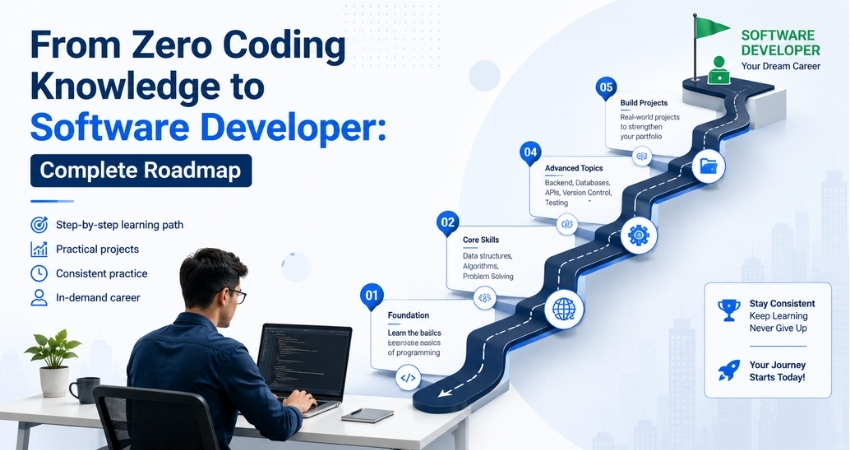
If you are typing “how to become a software developer with no coding experience” into Google at 11 PM, you are not alone. Thousands of graduates, career-switchers, and even college dropouts ask this exact question every month and the honest answer is: yes, you absolutely can become a software developer from zero, provided you follow a structured path instead of randomly jumping between YouTube tutorials.
This guide breaks down the complete zero to software developer roadmap what to learn, in what order, how long it takes, and how to convert that learning into an actual job offer. Whether you are a BCom graduate, an arts student, a fresher with a long career gap, or someone simply bored of your current job, this roadmap works.
Who Is This Roadmap For?
This coding roadmap for beginners is built for real people, not just computer science toppers. It works equally well for:
- Non-IT graduates BCom, BA, BBA, or any degree holder who never touched a code editor
- Engineering graduates who studied theory but never built a real project
- Job seekers with a career gap looking to restart in a high-demand field
- Working professionals wanting to switch into tech for better pay and stability
- 12th-pass students who want to skip a traditional degree and start working faster
If you fall into any of these categories and assumed coding was “not for you,” this roadmap proves otherwise.
Why Software Development Is Still One of the Best Career Choices in 2026
Before jumping into the “how,” it helps to understand the “why.” Demand for developers remains strong because every business from local retailers to global enterprises now runs on software, apps, websites, and AI-driven tools. A software developer career path offers:
- Strong starting salaries compared to most non-tech fields
- Remote and freelance opportunities across the globe
- Continuous growth into specialised, high-paying roles (AI, cloud, full-stack)
- No strict requirement of a “computer science only” background
Step-by-Step Roadmap: From Zero Coding Knowledge to Software Developer
Step 1: Build Your Foundation (Weeks 1–4)
Every learn to code from scratch journey starts with fundamentals. Skip this and everything afterward becomes harder.
- Understand how computers, the internet, and basic logic work
- Learn one beginner-friendly programming language Python or JavaScript are ideal starting points
- Practice basic concepts: variables, loops, conditions, functions, and arrays
- Solve small daily logic problems instead of only watching videos
Goal of this phase: comfort with writing simple programs without panic.
Step 2: Pick Your Developer Track (Weeks 5–8)
This is where most self-learners get stuck too many options, no direction. A clear track removes the confusion. Common options on this software developer roadmap include:
- Web Development: HTML, CSS, JavaScript, React, Node.js
- Mobile App Development: Flutter or React Native
- Data & AI: Python, SQL, Machine Learning basics
- Full-Stack Development: Frontend + backend + databases combined
Choosing one track and going deep beats trying to learn everything shallowly.
Step 3: Learn by Building Real Projects (Weeks 9–16)
Tutorials teach you syntax; projects teach you how to think like a developer. This is the single biggest gap between people who get hired and people who stay stuck in “tutorial hell.”
- Build a portfolio website, a to-do app, and a small e-commerce page
- Connect your frontend to a real database (MySQL, MongoDB, or PostgreSQL)
- Use Git and GitHub to manage and showcase your code professionally
- Debug your own errors instead of copy-pasting solutions blindly
This is also exactly why practical, project-based IT training outperforms purely theoretical courses real hiring managers care about what you’ve built, not just what you’ve studied.
Step 4: Learn Industry Tools & Workflow (Weeks 17–20)
Companies don’t just hire “coders” they hire people who can work inside a real development team. At this stage, focus on:
- Version control (Git/GitHub) and basic deployment
- API integration and working with third-party services
- Agile workflow basics sprints, standups, ticket-based tasks
- Light exposure to AI-assisted coding tools, now standard in 2026 development workflows
Step 5: Internship or Live Project Experience (Weeks 21–24)
This step separates serious candidates from the rest. A live project internship gives you:
- Real client requirements instead of imaginary practice problems
- Code reviews and feedback from working professionals
- Experience working in a team, under deadlines, with version control
- A genuine project to discuss confidently in interviews
This is precisely the gap that one-on-one, practical IT training and internship programs are designed to fill converting “I learned coding” into “I have shipped real work.”
Step 6: Resume, Portfolio & Interview Preparation (Weeks 25–26)
- Build a clean GitHub profile with 3–5 strong projects
- Create a developer resume focused on outcomes, not just tools used
- Practice common technical interview questions and logic-based rounds
- Prepare to explain your projects clearly interviewers test understanding, not memorisation
Step 7: Get Placed and Keep Growing
Once you land your first developer role, the learning doesn’t stop. The strongest software developer career path includes continuous upskilling cloud platforms, AI tools, and advanced frameworks to keep growing into senior, specialised, or higher-paying roles.
How Long Does It Actually Take to Become a Software Developer From Zero?
With consistent, structured effort, most learners following this zero to developer roadmap are job-ready in 6 to 9 months. Self-paced, unstructured learning often takes 2–3 times longer simply due to lack of direction, no real feedback, and no live project exposure.
Why Structured, Practical Training Speeds Up This Journey
Self-learning is possible, but it is slow and isolating. A structured, mentor-led program shortens the path by replacing guesswork with guidance. This is exactly the model used in practical, one-to-one IT training programs no large batches, real industry mentors, live project work, and continuous placement support until you actually get hired, not just “trained.”
Ready to Start Your Software Developer Journey?
Reading a roadmap is the easy part following it consistently, with the right guidance, is what actually gets you hired. If you want a practical, project-based, one-on-one IT training program that takes you from zero coding knowledge to a confirmed job offer, ExcelPTP has been doing exactly this since 2010.
Explore ExcelPTP’s Professional IT Training Programs or Contact Us for Free Career Counselling today and turn your coding ambition into an actual developer career.
Frequently Asked Questions
Can a complete beginner with zero coding background become a software developer?
Yes. With the right structured roadmap, consistent practice, and real project exposure, anyone regardless of degree or background can become job-ready in 6 to 9 months.
Which programming language should I learn first?
Python or JavaScript are the most beginner-friendly choices and form the foundation for most modern software developer career paths, including web, app, and AI development.
Do I need a computer science degree to become a developer?
No. Many successful developers come from commerce, arts, or unrelated science backgrounds. Skills and real project experience matter far more than the degree on paper.
What is the biggest mistake beginners make when learning to code?
Staying stuck in “tutorial hell” watching endless videos without building real, independent projects. Practical application is what actually builds developer skills.
Is online self-learning enough, or should I join a training program?
Self-learning works for some, but it is usually slower due to lack of feedback and real project exposure. A practical, mentor-led, project-based training program significantly speeds up the journey to becoming job-ready.
How important are internships in this roadmap?
Extremely important. Internships and live project training give you real-world experience, code review feedback, and project stories you can confidently discuss in interviews something tutorials alone cannot provide.
NEW COURSES


Contact Us
Trending Courses
Popular Posts
-
 June 29, 2026 Top 10 IT Training Courses For fresher india
 -

-
 June 29, 2026 10 Software Course You can learn in 6 Weeks or less