

Top AI Skills to Learn in 2026 for a High-Paying IT Career
Posted By:ExcelPTP
June 18,2026
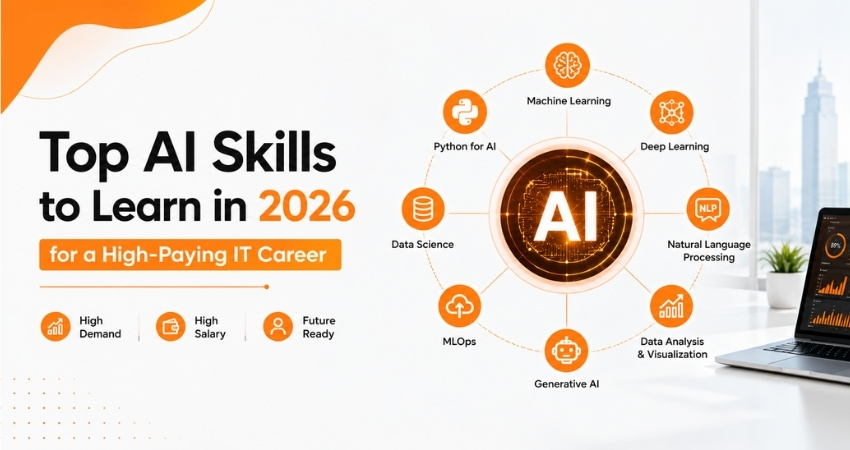
If you are researching the top AI skills to learn in 2026, the timing works in your favor. AI-related roles are now among the fastest-growing job categories in the IT industry, and companies are paying a real premium for professionals who can apply artificial intelligence to actual business problems, not just talk about it in an interview. Whether you are a fresher trying to land your first offer, a working developer planning a career switch, or a graduate from a completely different stream exploring tech, the right AI skill set can be the difference between a modest entry-level package and a high-paying IT career that compounds year after year. This guide breaks down which AI skills are actually driving hiring and salary growth right now, what each one involves in practice, and how to start learning them step by step.
Why AI Skills Are Now the Strongest Lever for a High-Paying IT Career
Hiring data from the last year tells a consistent story: AI-related job postings have grown several times faster than the overall IT job market, and roles that explicitly require AI skills now command a significant wage premium over comparable non-AI positions. In India specifically, AI and machine learning roles are projected to cross one million active positions by the end of 2026, with salaries growing 15 to 20 percent annually. For anyone planning an IT career in 2026, this is not a future trend to prepare for — it is already the current hiring reality, and the gap between candidates who have practical AI skills and those who only have a degree is where most of the salary difference comes from.
Top AI Skills to Learn in 2026 for a High-Paying IT Career
1. Prompt Engineering
Prompt engineering is the skill of designing precise instructions that get reliable, high-quality output from large language models like GPT and Claude. It has become one of the most accessible entry points into AI because it does not always require deep coding knowledge, yet it directly affects output quality across writing, analysis, automation, and customer support workflows. In India, prompt engineering roles range from around ₹6 LPA at entry level to ₹40–60 LPA for senior specialists who combine prompting with Python and retrieval systems. Tools to learn include ChatGPT, Claude, LangChain, and basic API integration.
2. Generative AI and LLM Development
Generative AI engineers build real applications on top of large language models — internal chatbots, document-processing tools, and AI copilots embedded inside business software. This is currently one of the highest-paying entry points in Indian IT, with freshers who have real project experience earning ₹8–12 LPA and senior LLM engineers crossing ₹35–60 LPA. Core tools include LangChain, vector databases, retrieval-augmented generation (RAG), and the OpenAI and Anthropic APIs.
3. Machine Learning and Deep Learning
Machine learning remains the foundation underneath almost every other AI skill on this list. ML engineers design and train models that predict outcomes, detect fraud, recommend products, and power computer vision and NLP systems. Strong Python skills, along with frameworks like Scikit-learn, TensorFlow, and PyTorch, are non-negotiable here. Fresher ML engineer salaries in India typically fall between ₹6 and 14 LPA, rising sharply with hands-on, deployed project experience.
4. AI Agent Development (Agentic AI)
Agentic AI is the newest and fastest-rising skill on this list. Instead of generating a single response, AI agents can plan, use tools, call APIs, and complete multi-step tasks on their own. Industry analysts expect a large share of enterprise applications to embed task-specific AI agents this year, and the talent pool for this skill is still small because the discipline barely existed two years ago. Learning frameworks like LangGraph, CrewAI, and AutoGen, along with function calling and agent memory design, can add a significant pay premium, with fresher roles in this space often starting higher than traditional ML positions.
5. MLOps and Model Deployment
A great AI model that never reaches production is worthless to a business. MLOps engineers take models out of notebooks and turn them into reliable, monitored, scalable systems using Docker, Kubernetes, MLflow, and CI/CD pipelines. Because this skill solves problems that directly affect company revenue, it is one of the better-paid specializations in AI, with senior MLOps engineers in India earning ₹45–60 LPA at product companies.
6. Natural Language Processing (NLP)
NLP is what allows machines to understand, summarize, translate, and generate human language. It underpins everything from chatbots to resume screening tools to sentiment analysis dashboards. Skills worth focusing on include tokenization, transformer architectures, fine-tuning pretrained models, and libraries like Hugging Face Transformers and spaCy.
7. Computer Vision
Computer vision teaches machines to interpret images and video, powering applications like facial recognition, quality inspection on factory lines, and medical imaging analysis. Learners should focus on image classification, object detection, image segmentation, and tools like OpenCV, TensorFlow, and PyTorch. This remains a strong, well-paid specialization, particularly in manufacturing, healthcare, and security-focused companies.
8. Cloud Computing and AI Tool Integration
Almost every AI system in production today runs on AWS, Azure, or Google Cloud. Knowing how to deploy models as APIs, manage cloud-based GPUs, and integrate AI into existing developer workflows is what separates someone who can prototype from someone who can ship. This is also where general developers can add AI skills without retraining as data scientists, simply by learning to integrate AI tools for developers into their existing stack.
How Much Can You Realistically Earn With These AI Skills in 2026?
Salary depends heavily on skill depth, project portfolio, and company type, but the pattern across the Indian IT market is consistent: candidates with demonstrable AI skills out-earn equally experienced peers without them, often by 30 to 50 percent. Freshers with a strong GitHub portfolio in generative AI or agentic AI development are now landing offers in the ₹8–16 LPA range straight out of college, while the same fresher profile without AI skills typically starts at ₹3–5 LPA. At the mid and senior level, the gap widens further, with specialists in MLOps, LLM engineering, and AI agent architecture crossing ₹40–70+ LPA. The consistent factor behind every one of these numbers is practical, project-based skill, not just a certificate.
How to Start Learning AI Skills in 2026 (Even With Zero Coding Background)
You do not need a computer science degree to start. Begin with one skill instead of trying to learn everything at once. If you come from a non-technical background, prompt engineering and AI tool integration are the most accessible starting points and do not require heavy coding. If you are comfortable with logic and want a long-term technical career, Python is the single most important language to learn first, since it is the foundation for machine learning, generative AI, and agent development. From there, build at least two or three real, deployed projects rather than collecting certificates, because that portfolio is what recruiters and interviewers actually evaluate. Structured, practical, mentor-guided training — like the one-on-one, project-based programs in Prompt Engineering, Generative AI, and AI Tools for Developers offered at ExcelPTP — can shorten this learning curve significantly and connect that skill directly to a placement-ready portfolio rather than leaving it as theory.
Conclusion: Build Your IT Career Around AI Skills, Not Around a Degree Alone
The IT job market in 2026 is no longer rewarding generic degrees or theoretical knowledge alone. It is rewarding people who can prove, through real projects, that they can use AI to solve actual problems. Whether your path leads toward prompt engineering, generative AI development, machine learning, or AI agent architecture, the highest-paying IT careers this year all share one thing in common: practical, demonstrable AI skill. Start with one skill, build something real with it, and let that project open the door to the next.
Frequently Asked Questions
Which AI skill is best for a high-paying IT career in 2026?
Agentic AI development and generative AI engineering currently offer the highest starting salaries for freshers in India, while machine learning and MLOps continue to offer strong, stable long-term growth.
Can I learn AI skills without a coding background?
Yes. Prompt engineering, AI tool integration, and AI-assisted data analysis can be learned with little to no coding experience, making them a realistic entry point into a tech career for graduates from any stream.
How long does it take to become job-ready in AI in 2026?
With focused, practical training, most learners can become job-ready in three to six months, provided the learning includes real projects rather than only video lectures.
Do I need a computer science degree to get an AI job?
No. Recruiters in 2026 increasingly prioritize a demonstrated project portfolio and hands-on skills over a specific degree, which is why graduates from commerce, arts, and other non-technical streams are successfully entering AI-driven IT roles.
Which programming language should I learn first for AI?
Python is the standard starting point for almost every AI career path, including machine learning, generative AI, and AI agent development, because of its extensive libraries and community support.
Is prompt engineering still worth learning in 2026?
Yes. While the skill has matured, professionals who combine prompt engineering with Python and retrieval-augmented generation continue to earn a strong premium, especially in product, EdTech, and enterprise automation roles.
NEW COURSES


Contact Us
Trending Courses
Popular Posts
-
 June 18, 2026 Top 10 IT Training Courses For fresher india
 -

-
 June 18, 2026 10 Software Course You can learn in 6 Weeks or less