
Will AI Kill IT Jobs Completely?
Posted By:ExcelPTP
December 03,2025
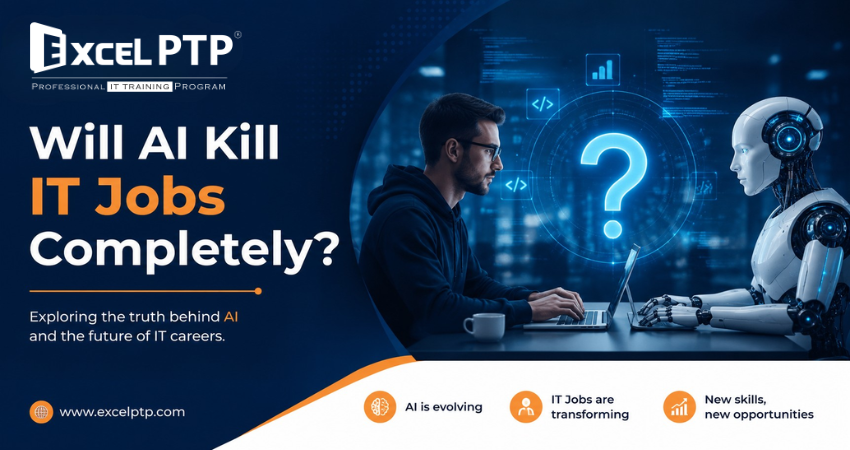
Artificial Intelligence (AI) has become one of the most disruptive forces in the IT industry today. With code-generation tools such as GitHub Copilot and ChatGPT now embedded in everyday workflows, and automation platforms handling tasks once done manually, one question keeps coming up among tech professionals: is AI taking jobs in IT?
Is AI Really Taking Jobs in IT?
Here’s the honest answer: AI is unlikely to wipe out IT jobs entirely but it will replace IT professionals who don’t update their skill sets. Rather than eliminating roles outright, AI in the IT industry is reshaping how those roles function. Organisations still rely heavily on human talent, but increasingly, they want people who can collaborate with AI tools rather than compete against them.
Let’s break down exactly which departments are feeling the biggest AI impact on IT jobs, why this shift is happening, and how today’s workforce can prepare.
Which IT Departments Are Most Affected by AI?
Not every team feels the effects of automation equally. Some job functions are shrinking due to AI, while others are expanding precisely because of it.
1. Software Development (Moderately Affected)
AI coding assistants like Copilot, ChatGPT, Replit, and Amazon CodeWhisperer can already:
- Write boilerplate code
- Auto-generate functions
- Optimise existing code
- Detect bugs
- Assist with documentation
What’s changing?
Developers are spending less time on repetitive coding and more time on higher-value work such as:
- Architecture and system design
- Debugging complex issues
- Integrating AI models into products
- Building complex business logic
Who feels it most?
- Junior developers
- Freshers relying only on basic syntax knowledge
In-demand skills:
- AI-assisted coding
- Prompt engineering
- System design
- DevOps and automation
- Cloud-native development
2. Quality Assurance & Testing (Highly Affected)
AI-driven testing tools can already:
- Generate test cases automatically
- Run automated regression tests
- Flag UI and layout changes
- Predict likely bug locations
What’s changing?
Manual QA work is shrinking fast, as automation testing combined with AI becomes the industry standard.
Who feels it most?
- Manual testers without automation experience
In-demand skills:
- Automation testing (Selenium, Cypress, Playwright)
- AI-based testing platforms (Testim, Mabl, Functionize)
- API testing
- Performance testing
- DevOps testing
3. IT Support / Helpdesk (Very Highly Affected)
AI chatbots and automated IT support platforms now routinely manage:
- Password resets
- Basic troubleshooting
- Frequently asked IT queries
- System monitoring alerts
- Ticket categorisation and routing
Who feels it most?
- L1 support engineers
- Entry-level helpdesk roles
In-demand skills:
- Cloud support (AWS, Azure, GCP)
- Cybersecurity fundamentals
- SRE (Site Reliability Engineering)
- AI Ops and monitoring tools
4. Data Entry, Documentation & BPO Roles (Extremely Affected)
AI performs exceptionally well on repetitive, rules-based workloads such as:
- Data entry and validation
- Document processing
- Text summarisation
- Report generation
Unsurprisingly, these roles are experiencing the highest levels of automation.
Who feels it most?
- Roles built around routine, repetitive data processing
In-demand skills:
- Data analysis and visualisation
- Business Intelligence (BI) tools
- RPA (Robotic Process Automation)
5. UI/UX Design (Moderately Affected)
AI design tools can now generate:
- Wireframes
- Design suggestions
- Basic prototypes
Yet genuine creativity, user empathy, and research remain firmly human skills.
Who feels it most?
- Designers doing only basic layout work without UX thinking
In-demand skills:
- UX research
- Design systems and components
- AI-assisted design tools
- User testing and analytics
6. Project Management (Low Impact, But Evolving)
AI supports project managers with tasks like:
- Task estimation
- Timeline prediction
- Risk analysis
- Resource planning
Leadership, decision-making, and stakeholder communication, however, remain distinctly human strengths.
In-demand skills:
- AI-enabled project management tools
- Agile & Scrum with automation
- Data-driven decision making
Why Is AI Affecting IT Jobs?
Several clear drivers explain why AI is reshaping IT jobs so quickly:
- Speed and efficiency: AI tools cut development and support time significantly.
- Repetitive tasks are easy to automate: Anything predictable or rule-based is a prime automation target.
- Cost savings: AI reduces the need for large teams handling simple, repeatable tasks.
- Global competition: Employers increasingly favour employees who use AI to boost productivity.
What Skills Do You Need to Survive the AI Wave?
Staying relevant in this environment means upgrading your skills, not panicking. Here’s where to focus:
1. AI-Assisted Coding & Prompt Engineering
Developers should learn to use AI tools to:
- Generate and refactor code
- Debug and troubleshoot issues
- Optimise performance
AI won’t replace skilled developers but developers who master AI-assisted coding will replace those who don’t.
2. Automation Skills (Especially for QA & Testing)
Key tools and focus areas:
- Selenium, Cypress, Playwright
- API & integration testing
- Performance & load testing
- AI-powered testing platforms
3. Cloud Computing
High-demand cloud computing roles include:
- AWS, Azure, GCP engineers
- Cloud DevOps
- Cloud security specialists
4. Data & AI Fundamentals
Even foundational knowledge offers a real advantage:
- Python basics
- Machine learning fundamentals
- Using AI APIs and services
- Data analysis and dashboards
5. Cybersecurity
As AI adoption grows, so does the threat surface making cybersecurity roles more essential, not less.
Key focus areas:
- Ethical hacking
- Network and application security
- SOC tools & monitoring
- Vulnerability assessment
6. Soft Skills (Still Impossible to Automate)
Certain capabilities remain uniquely human:
- Problem-solving
- Creativity
- Communication
- Leadership
- Critical thinking
Will AI Kill IT Jobs Completely?
No but AI will phase out many low-skill, repetitive IT jobs.
At the same time, AI is creating entirely new IT career paths, including:
- AI Developer
- AI Trainer
- Prompt Engineer
- Automation Architect
- AI QA Analyst
- Data & AI Strategist
- AI Product Manager
AI isn’t simply a job killer it’s a job transformer.
How Excel PTP Helps You Stay Ahead in an AI-Driven IT Industry
Excel PTP prepares learners for the future of IT by focusing on the real-world skills AI cannot replicate. Rather than relying on theory alone, Excel PTP delivers hands-on training in modern tools, coding practices, automation frameworks, and live projects making graduates industry-ready from day one.
You won’t just learn to code you’ll learn to work alongside AI-powered tools, automation systems, and cloud technologies that today’s companies depend on daily. From AI-assisted coding to DevOps and automation testing, Excel PTP builds the practical, job-ready skills that keep you employable as AI reshapes the IT job landscape.
Whether your goal is to become a developer, tester, designer, or cloud engineer, Excel PTP helps you build the mindset, problem-solving ability, and technical confidence to thrive in a career where AI is a daily collaborator, not a competitor.
AI won’t take every IT job but it will fundamentally change how those jobs get done.
Professionals who upgrade their skills, embrace AI tools, and learn automation will grow faster than ever. Those who stick to outdated methods and resist learning risk falling behind.
The future belongs to IT professionals who learn to work WITH AI not against it.
NEW COURSES


Contact Us
Trending Courses
Popular Posts
-
 December 3, 2025 Top 10 IT Training Courses For fresher india
 -

-
 December 3, 2025 10 Software Course You can learn in 6 Weeks or less